
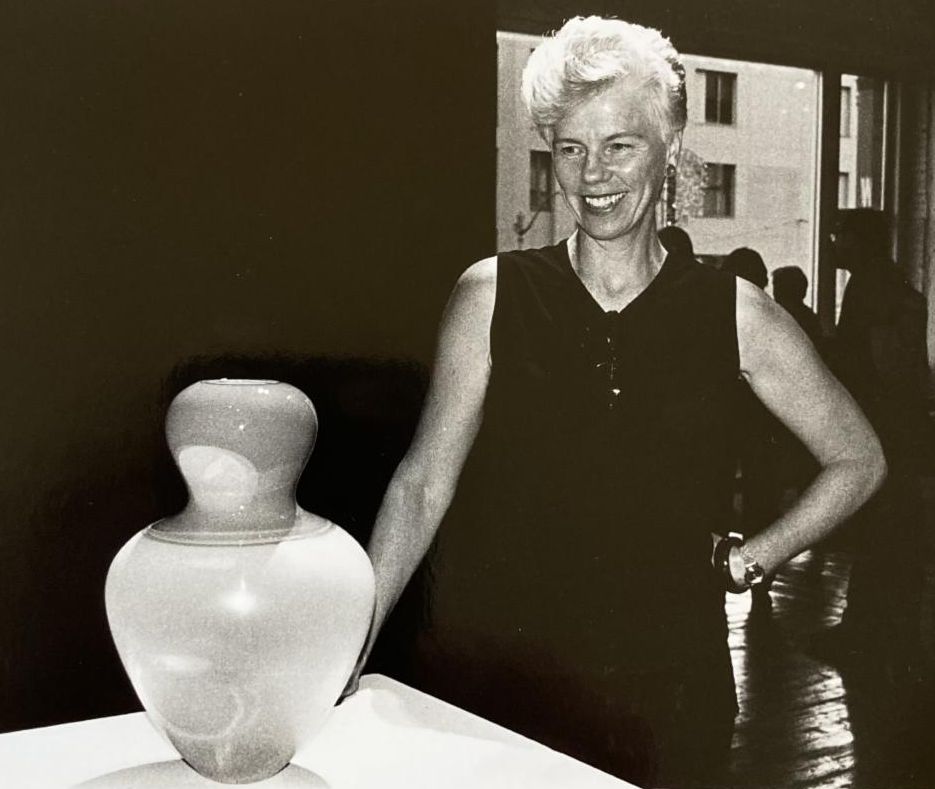
For decades, glass artist Sonja Blomdahl worked in her Seattle studio, creating luminous vessels that caught light and color in a way that seemed to hold hope inside them. She was no stranger to discipline, teamwork, and the physicality of creation. But nothing prepared her for the physical and emotional intensity of a cancer diagnosis.
In June 2022, after years of routine mammograms, Sonja expected another “all clear.” Instead, she entered a summer of callbacks, repeat tests, and mounting uncertainty. By August, the words she had feared were on paper: lobular breast cancer, a subtype that often evades mammograms.
“When I saw that long report full of numbers and centimeters, I thought, ‘I’m toast.’ It was shocking. I never imagined I would get breast cancer.”
Sonja began treatment at Fred Hutchinson Cancer Center—a place with unexpected resonance. For 25 years her glassblowing studio had been located near their campus, eventually becoming part of the neighborhood as Fred Hutch grew around her.
“It was like coming full circle,” she reflects. “Now I was back there, but as a patient.”
Sonja endured a full year of intensive treatment. Along the way she made lifestyle changes—quitting sugar, alcohol, and coffee—to regain a sense of control. “I needed something I could do for myself,” she says.
Living With Survivorship
Although treatment ended, survivorship brought its own challenges. Sonja developed lymphedema—a swelling in her arm that requires daily management. What started with a compression sleeve became a year of specialized care at the Ace Clinic.
“It’s like graduating from college after treatment—they tell you to ‘go live your life.’ But what does that mean when cancer is still part of you?”
Saying Yes to Support
Through it all, Sonja has leaned into support. She found community at Cancer Lifeline, where she joined Zoom classes on nutrition, exercise (yoga and bone-strength), and educational sessions on stress management and lymphedema. She also participated in an in-person sound bath workshop with gongs.
“I’ve said yes to everything offered—extra MRIs, acupuncture, classes, support groups. Even if I just get one nugget of help, it’s worth it. And being in community with others who understand makes me feel less alone.”
Cancer Lifeline’s framework of information, inclusion, expression, and choice resonated deeply.
“It’s not just about facts—it’s about being seen without judgment and learning to live fully even with uncertainty.”
Lessons Learned
One of Sonja’s most important messages is about self-advocacy and screening. Her lobular cancer didn’t show up on mammograms at first, and her concerns were initially dismissed.
“Just because you get a negative mammogram doesn’t always mean nothing is there. If you feel something, keep asking. Trust your instincts.”
Moving Forward
Today, Sonja is in regular monitoring, with mammograms and follow-up care every few months. She no longer creates glass art, but the meaning of her work continues to live on. Her vessels in collections and hospitals, including Fred Hutch, remain reminders of beauty, fragility, and resilience—symbols of the very qualities she draws on in her own life.
“I’m learning what it means to live with cancer, not just past it. I try to be real about it—not pretending everything is fine, but not letting it stop me from living either.”
Sonja’s story is one of courage, persistence, and openness. In saying yes—to treatment, to support, and to community—she has found her own light shining through uncertainty. And in sharing her journey, she reminds us all: listen to your body, pursue regular screenings, and never stop seeking the care and connection you deserve.
Would you like to share your Cancer Lifeline or Harmony Retreats story with us? Contact Our Communications Team