
For the past two years, Cancer Lifeline has had the honor of serving as both a planning partner and activity presenter for the South Puget Intertribal Planning Agency (SPIPA) Cancer Survivor Celebration — a gathering created to honor and uplift cancer survivors from the five South Puget tribal communities: the Nisqually Indian Tribe, Squaxin Island Tribe, Skokomish Tribe, Chehalis Tribe, and Shoalwater Bay Tribe.
This year, Cancer Lifeline staff member Victrinia Ridgeway facilitated a healing circle during the event. The following editorial reflection shares her experience of holding that circle, and of a quiet act of returning a cedar frond — gifted by Nisqually Native Healers — back to the sea. It is a meditation on witness, grief, community, and the sacred ways healing can move through both people and the natural world.
__________________________________________
The Sea Carried It Home
Reflections from a healing circle at the SPIPA Cancer Survivor Celebration
There are moments in community work that feel less like programming and more like ceremony. Not because anyone declared them sacred with fanfare, but because something older quietly arrived and took its place among the people gathered there.
The healing circle at the SPIPA Cancer Survivor Celebration was one of those moments.
It was the second circle we had held there, and again the people came carrying the full truth of survivorship with them. Tribal members from across the region sat together and shared stories that moved fluidly between laughter and grief, fear and gratitude, exhaustion and meaning. There is something profoundly human that happens when people who have suffered are no longer asked to perform strength for one another. The circle became a place where people could simply be witnessed.
Not fixed.
Not instructed.
Not hurried toward optimism.
Just heard.
At the center of the circle table rested a cedar frond given to us by the Nisqually Native Healers. I had wanted the natural world present among us, because healing circles are not meant to exist apart from creation. The land listens too. The waters listen. The trees hold memory in ways many of us were taught to forget.
When the healers handed me the cedar, I told them I could bring it back afterward.
They gently told me no.
What had been shared around it should not simply return to ordinary use. The cedar had sat with stories of illness, survival, mourning, resilience, love, fear, gratitude, and hope. It had borne witness. They explained that it should either be burned or returned to creation so what it carried could move back into the natural world.
I told them I had no way to burn it properly, though I understood why fire would traditionally be used. So I asked another question instead:
“Could I give it to the sea?”
They smiled.
They said that was a good thing to do… especially there, on the lands and waters of the Quinault people.
So on the final day, I carried the cedar to the ocean.
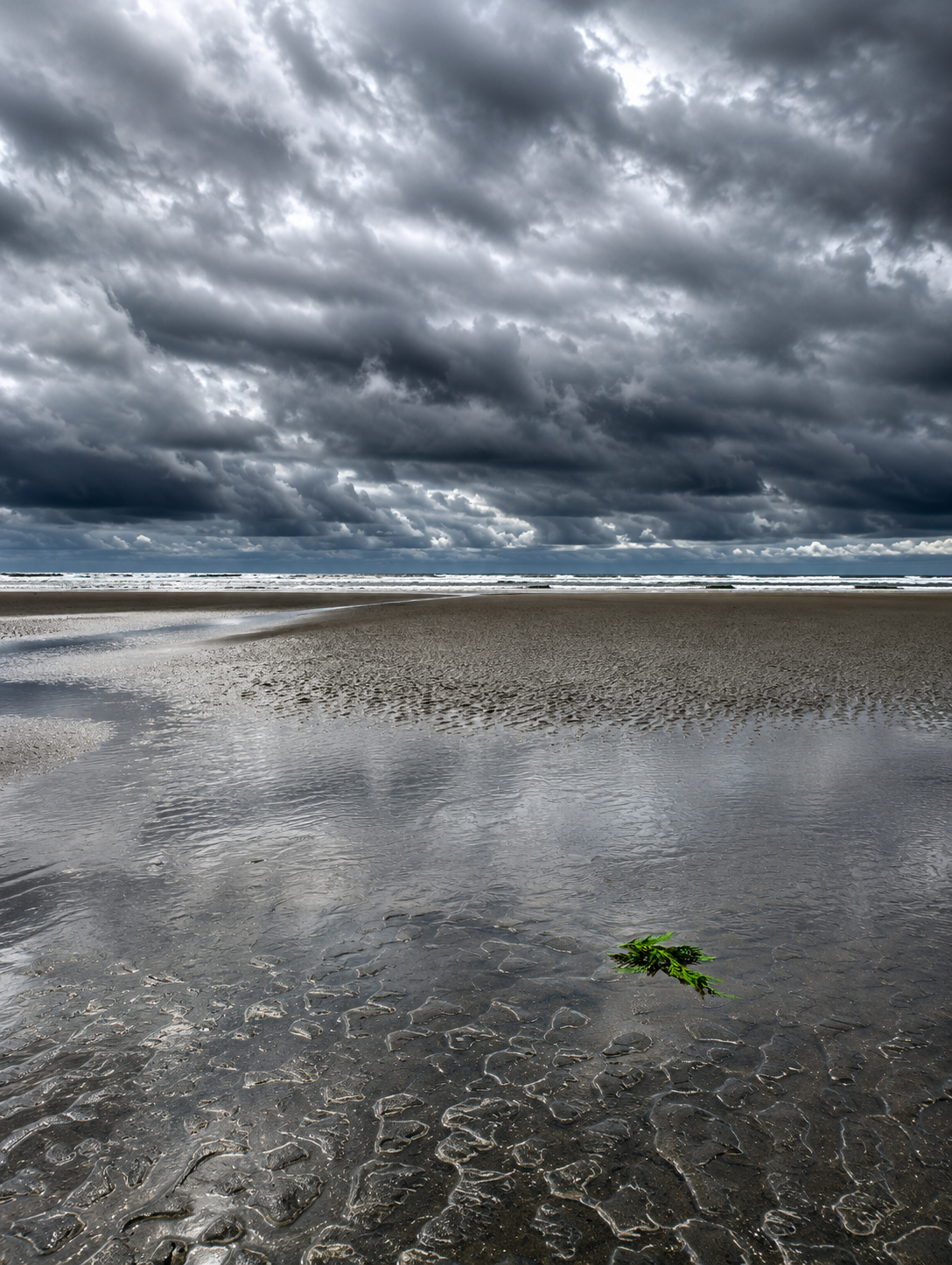
The beach would not fully yield passage to the waves, so I found a tidepool nearest to the incoming sea and laid the frond gently into the water. Then I sang the songs of my own people — CHamoru songs carried across generations of island memory and saltwater belonging. In that moment, the distance between Guam and the Salish Sea did not feel so large. Indigenous peoples separated by an ocean still understand certain things instinctively: that grief belongs somewhere, that nature can carry what human hearts cannot hold forever, and that the waters remember.
And then I waited.
Dozens of gulls gathered around the tidepool, watching with startling stillness. They did not descend upon the cedar. They did not scatter. They simply remained there with me, as though they too understood this was not debris, but offering.
Together we watched the tide rise.
The sea came closer and closer until eventually both the gulls and I were forced backward by the incoming water. The tidepool disappeared beneath the surge, and the cedar frond was taken into the great body of the ocean.
Returned.
Not discarded.
Not lost.
Returned.
There is something deeply healing in recognizing that suffering does not need to vanish to be transformed. Sometimes it only needs to be carried by something larger than ourselves for a while. Community does this. Ceremony does this. The sea does this.
And perhaps that is part of what healing circles truly are.
Not places where pain disappears.
But places where we no longer carry it alone.
The Sea and the Cedar
Gulls kept silent watch
As cedar returned to sea
The tide carried prayers
Victrinia Ridgeway